Term and definition
What is hot-dip galvanizing after fabrication?
Hot-dip galvanizing after fabrication means the steel grating panel is cut, welded, banded and finished first, and only then immersed in a bath of molten zinc. The zinc reacts with the steel to form a series of iron-zinc alloy layers topped by a layer of nearly pure zinc.
The alternative — galvanizing the raw bars or sheet before they are made into panels — leaves every cut edge, weld and drilled hole as bare steel. For a component that is mostly edges and intersections, that difference decides how long the panel lasts.
- Hot-dip means full immersion in molten zinc, not sprayed or electroplated zinc.
- After fabrication means all cutting, welding and drilling is completed before the bath.
- The coating is bonded, not painted on: it is a metallurgical reaction layer, so it does not peel like a film.
- Protection is sacrificial: zinc corrodes in preference to the steel, so small scratches and abrasions do not immediately rust.
Why the sequence matters on steel grating
A grating panel has far more exposed edge length per square metre than a plate or a beam. Every bearing bar has two cut ends, every cross bar is exposed, and every one of hundreds of weld points is a potential starting point for corrosion.
| Sequence | What is coated | What is left bare |
|---|---|---|
| Galvanize raw bars, then fabricate | Bar surfaces produced at the mill | All cut ends, weld zones, drilled holes and banding welds |
| Fabricate, then hot-dip galvanize | Every surface including cut ends, weld points, banding and internal gaps | None, provided venting and drainage are designed correctly |
- Field cuts made after galvanizing must be treated on site with a zinc-rich repair coating.
- Frames, hinges and locking hardware should be planned with the coating thickness in mind, not fitted to bare-steel dimensions.
- The panel must be vented and drained so zinc can flow in and out of closed sections; this is a fabrication design decision, not a bath setting.
Process steps
The sequence below is the standard flow for after-fabrication galvanizing. Bath temperature, immersion time and withdrawal speed are set by the galvanizer according to steel thickness and panel geometry.
Degreasing
Oil, grease, marking paint and fabrication residues are removed in an alkaline or solvent cleaning bath.
Rinsing
The panel is rinsed to stop cleaning chemicals from being carried into the next stage.
Pickling
Mill scale and rust are dissolved in acid, leaving a chemically clean steel surface.
Fluxing
A flux layer is applied so the molten zinc can wet and react with the steel during immersion.
Immersion in molten zinc
The whole panel is submerged until it reaches bath temperature and the alloy layers have formed.
Withdrawal, cooling and inspection
The panel is withdrawn at a controlled rate, cooled, then checked for coverage, thickness and finish.
- Cleaning quality controls the coating more than any other single step: poor pickling shows up directly as bare spots.
- Immersion is complete only when the panel stops giving off gas and has reached bath temperature.
- Panels are racked so zinc can drain; hang marks and drainage runs are normal features of the process.
Edges, welds and internal gaps
- Cut ends receive the same coating as the flat surfaces because they are immersed together with the rest of the panel.
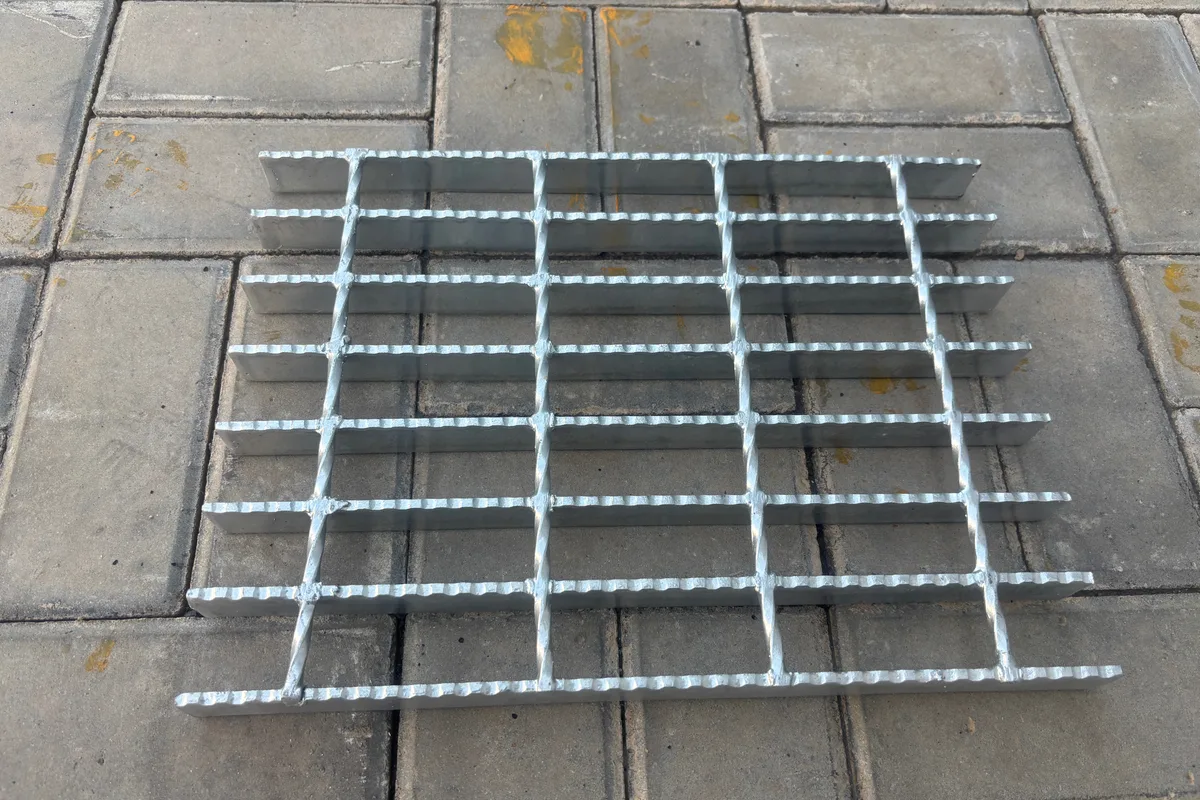
- Weld zones are coated as part of the panel, so the resistance welds of the grating are not weak points for corrosion.
- Overlapping surfaces such as banding against bearing-bar ends need zinc to flow between them; tight, sealed laps can trap pickling solution and must be vented or sealed by weld.
- Closed frames and boxed sections need vent holes at the highest point and drain holes at the lowest point so the bath can fill and empty safely.
- Threads and machined fits gain thickness and may need to be tapped after galvanizing or masked before it.
Coating and expected service behaviour
Coating behaviour is governed by the environment, not by a single number. The practical points for specifying grating are these.
- Coating thickness depends mainly on steel thickness and surface condition; heavier bar sections generally carry a thicker coating than light-gauge work.
- Zinc is consumed at a roughly steady rate, so a thicker coating means a longer period before the steel underneath begins to rust.
- Indoor, dry interiors can last for decades with little loss; coastal, chemical and permanently wet environments consume zinc far faster.
- Paint over galvanizing is a duplex system and can extend life further, but it requires a compatible primer and surface preparation.
- Stainless steel grating is a different material decision, not a heavier version of galvanizing; do not substitute one for the other without reviewing the environment and budget.
What to check on delivery
- Coverage is continuous, with no uncoated patches at cut ends, weld zones or inside frames.
- No heavy runs, spikes or dross lumps that would obstruct foot traffic or prevent a cover seating flat.
- Coating thickness measured with a calibrated gauge on representative bar faces, not only on one convenient spot.
- Panels are flat and free of distortion; thin panels and long spans distort more readily in the bath.
- Cut-outs, hinges and lifting handles still fit and operate with the added coating thickness.
- Packing allows air movement; wet, tightly wrapped bundles develop white storage stain during transit.
Common problems and how they are avoided
| Symptom | Usual cause | How it is avoided |
|---|---|---|
| Bare spots or black patches | Incomplete cleaning, trapped flux or overlapping surfaces | Correct racking, adequate venting, welding laps instead of leaving tight seams |
| White powdery deposit | Wet storage stain from stacked wet panels with no airflow | Dry and separate panels promptly, store ventilated and off the ground |
| Distortion or bowing | Thin section released from thermal stress unevenly | Discuss panel size and bar section before galvanizing; plan support details |
| Threads that will not fit | Coating thickness on fasteners and machined parts | Tap oversize before galvanizing or re-tap after; state the requirement in the order |
| Excess zinc runs | Poor drainage during withdrawal | Accept normal drainage marks; specify removal of sharp spikes where foot contact occurs |
What to state in an order
Galvanizing is a fabrication input, not an afterthought. These items should be written into the enquiry so the panel is designed for the bath from the start.
- Finish required: hot-dip galvanized after fabrication, painted, or untreated for on-site coating.
- Applicable coating standard and any required minimum thickness, if the project specifies one.
- Whether frames, boxes or enclosed sections are included, so venting and drainage can be provided.
- Whether hardware, hinges or threaded parts are to be galvanized with the panel or supplied separately.
- Whether field cutting is expected, so a zinc-rich repair coating can be supplied with the delivery.
- Environment of use: indoor, exterior, coastal, chemical or submerged, plus expected inspection access.
- Quantity, panel sizes, delivery destination and required date.
Handling and storage cautions
- Do not store freshly galvanized panels tightly stacked or wrapped while still damp.
- Keep bundles ventilated, off the ground and separated with spacers during site storage.
- Lift with slings or spreader bars that do not drag zinc spikes across the coating.
- Treat every field cut, drilled hole and weld repair with a zinc-rich coating before installation.
- Avoid prolonged contact with copper, brass or untreated steel run-off that accelerates local corrosion.
- Do not grind away the alloy layers to remove a cosmetic mark; the layers beneath are the protection.
Hot-Dip Galvanizing FAQ
Can grating be galvanized before it is cut to size?
It can, but every cut edge will be bare steel. After-fabrication galvanizing exists specifically to avoid that, and it is the default for industrial grating.
Does galvanizing change the panel dimensions?
Yes, slightly. The coating adds thickness to every surface, so frames, clips, hinges and removable covers must be dimensioned with the coating in mind.
Is a bright, shiny finish better than a dull grey one?
Appearance depends on steel composition and cooling rate, not on corrosion performance. A dull grey coating can be as protective as a bright one.
What should be done about cuts made on site?
Clean the area and apply a zinc-rich repair coating. Leaving a site cut untreated defeats the purpose of after-fabrication galvanizing.
Can galvanized grating be painted later?
Yes, with the correct surface preparation and a compatible primer. Tell the supplier if a paint system will follow so the galvanizing is not passivated or sealed against it.
Request a project quotation
Send the panel sizes, bar configuration, finish requirement, environment and quantity. We can review the galvanizing and fabrication sequence together with the drawing.